
News
Logistics & Freight Market Insights for Shippers – October 20, 2026
October 20, 2026 | Shipper Update | 10 – 12 Minute Read
Tight Capacity, Rising Fuel Costs and Q4 Freight Pressure Keep Shippers on Alert
The U.S. freight market continues to tighten as we move deeper into Q4, and this week’s fuel report adds another concern for shippers. After three consecutive weeks of declines, diesel reversed course and climbed 9.7 cents to $6.276 per gallon nationally, with prices increasing in every major U.S. region. At the same time, national truckload tender rejections remain near 13.9% even as accepted freight volumes have fallen more than 4% over the past month. Capacity is particularly tight in the Northwest, where overall tender rejections reached 20.27% and reefer-specific rejections have averaged approximately 41% during October. Contract rates are also moving higher, imports remain historically strong and intermodal continues to gain freight. The message for shippers is becoming clearer: there isn’t much excess transportation capacity available, and fuel costs remain extremely volatile. Heading toward Thanksgiving and the holidays, early planning, dependable carrier relationships and lane-level market intelligence will become increasingly important.
Read my take below on the latest news impacting shippers this week…
The Biggest Freight Story Is Still Capacity
If you only look at freight volumes, today’s truckload market can be confusing.
Accepted truckload volumes have actually fallen more than 4% during the past four weeks, reaching their lowest level outside of a holiday week since January.
Normally, you’d expect a decline like that to create plenty of available trucks and push rates lower.
That’s not happening.
National truckload tender rejections remain around 13.9%. A year ago, shippers entered peak season with rejection rates below 6%.
That’s a significant change.
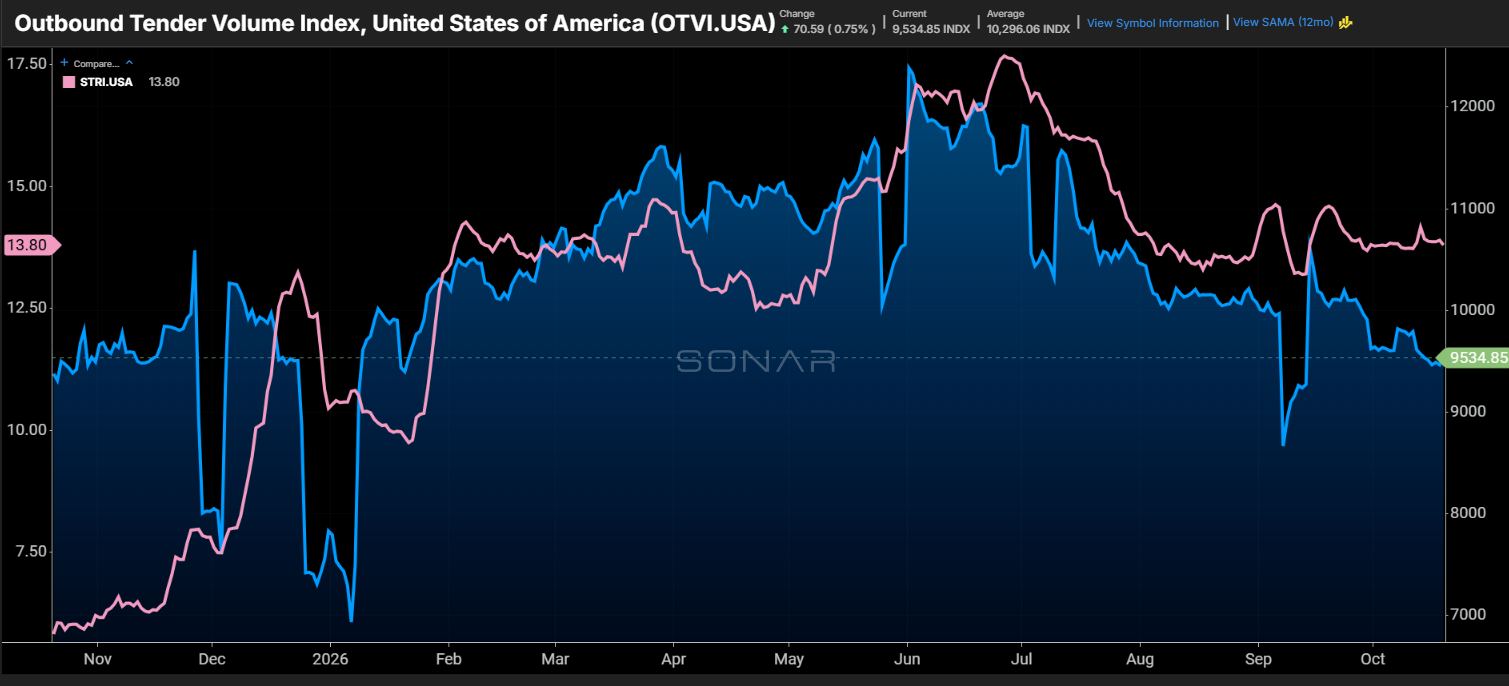
Essentially, carriers are rejecting more than twice the percentage of contracted freight they were rejecting a year ago—even though accepted freight volume is actually lower.
That tells us something important about today’s market:
This isn’t primarily a freight-demand problem. It’s increasingly a truck-supply problem.
There simply aren’t as many trucks competing for the freight that’s available.
What does that mean for shippers?
A market with very little excess capacity can change quickly.
It doesn’t necessarily take a massive increase in freight demand. Thanksgiving, Christmas, winter weather, produce activity or even a short-term regional surge can suddenly put a lot more shipments in competition for a limited number of trucks.
Our recommendation: Don’t mistake softer freight volumes for abundant capacity. Give important shipments as much lead time as possible and establish backup capacity before you actually need it.
Northwest and Midwest Capacity Deserve Special Attention
National averages don’t always tell the whole story.
The Northwest recently became the tightest freight region in the country, with its overall tender rejection rate reaching 20.27% on October 8.
That’s more than triple the 6.2% rejection rate recorded in the region a year ago.
The Midwest isn’t far behind, with overall tender rejections around 18.61%.
But there’s an important difference between the two markets.
The Midwest has been relatively tight throughout much of 2026. The Northwest tightened dramatically beginning in August, largely because of refrigerated freight associated with the fall harvest.
And that’s where the numbers become especially interesting.
While the Northwest’s overall tender rejection rate reached 20.27%, Northwest reefer rejection rates have peaked at 54% in October, compared with roughly 17% in July and 16% last October.
Meanwhile, Northwest van rejections remain below 5%.
That’s a huge difference between equipment types.
Reefer tender volume in the Northwest has increased approximately 65% since July and 35% year over year, as apple and potato harvests in Washington, Oregon and Idaho compete for temperature-controlled equipment.
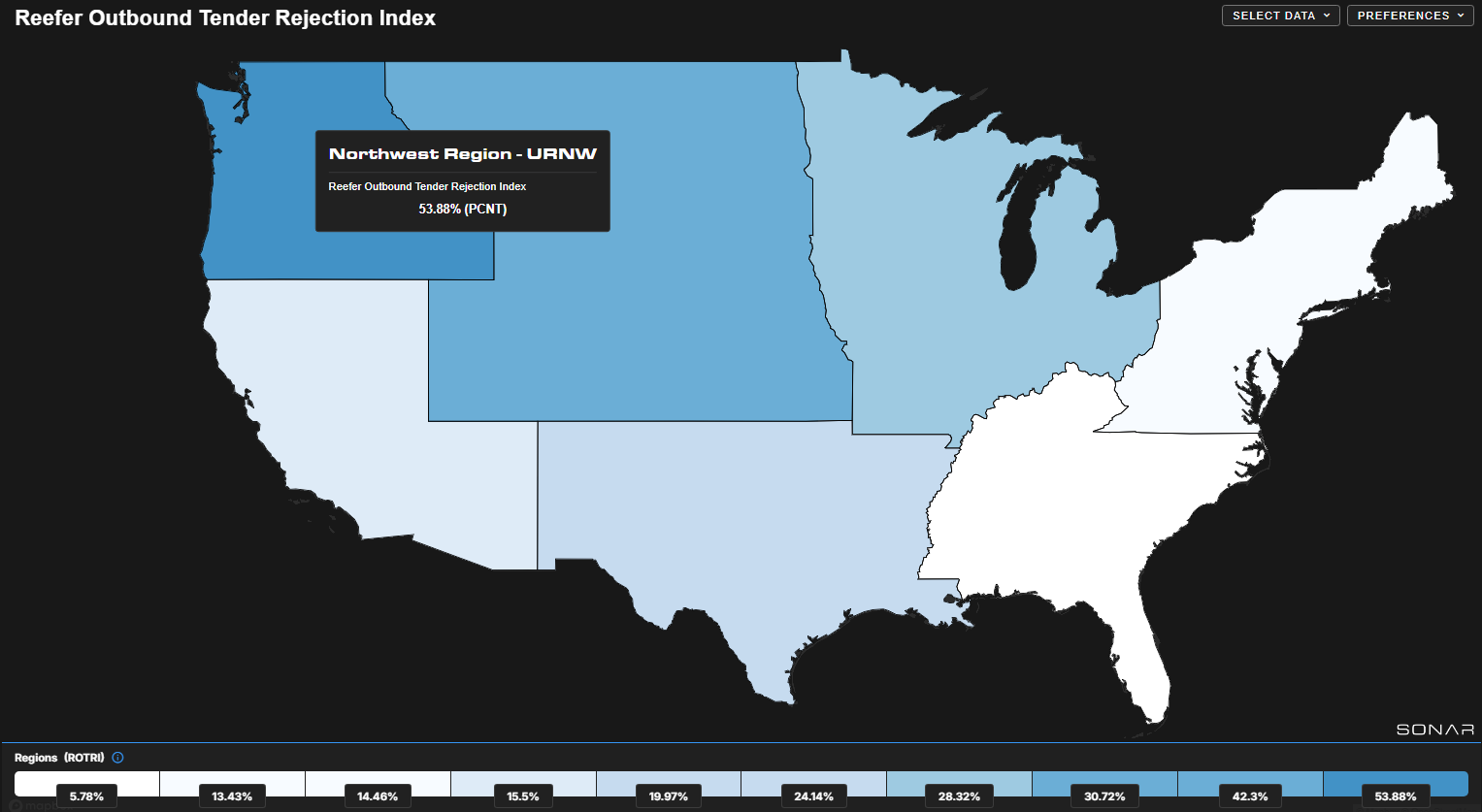
The Midwest is a different story. Tightness there is much broader. Overall rejections are approximately 18.6%, van rejections are near 15%, and reefer rejections are around 29%.
What does that mean for shippers?
If you’re moving refrigerated freight out of Washington, Oregon or Idaho right now, a national reefer average isn’t particularly useful.
You’re competing in a market where refrigerated equipment is extremely tight.
The Midwest deserves attention for a different reason. Its capacity issues appear broader and more persistent, making it potentially more significant to the overall direction of the national truckload market.
Our recommendation: Pay attention to the market your freight is actually moving in—not just national averages.
Diesel Reverses Course and Moves Higher Again
Just when it looked like shippers might finally be getting some sustained relief on fuel, diesel moved higher again.
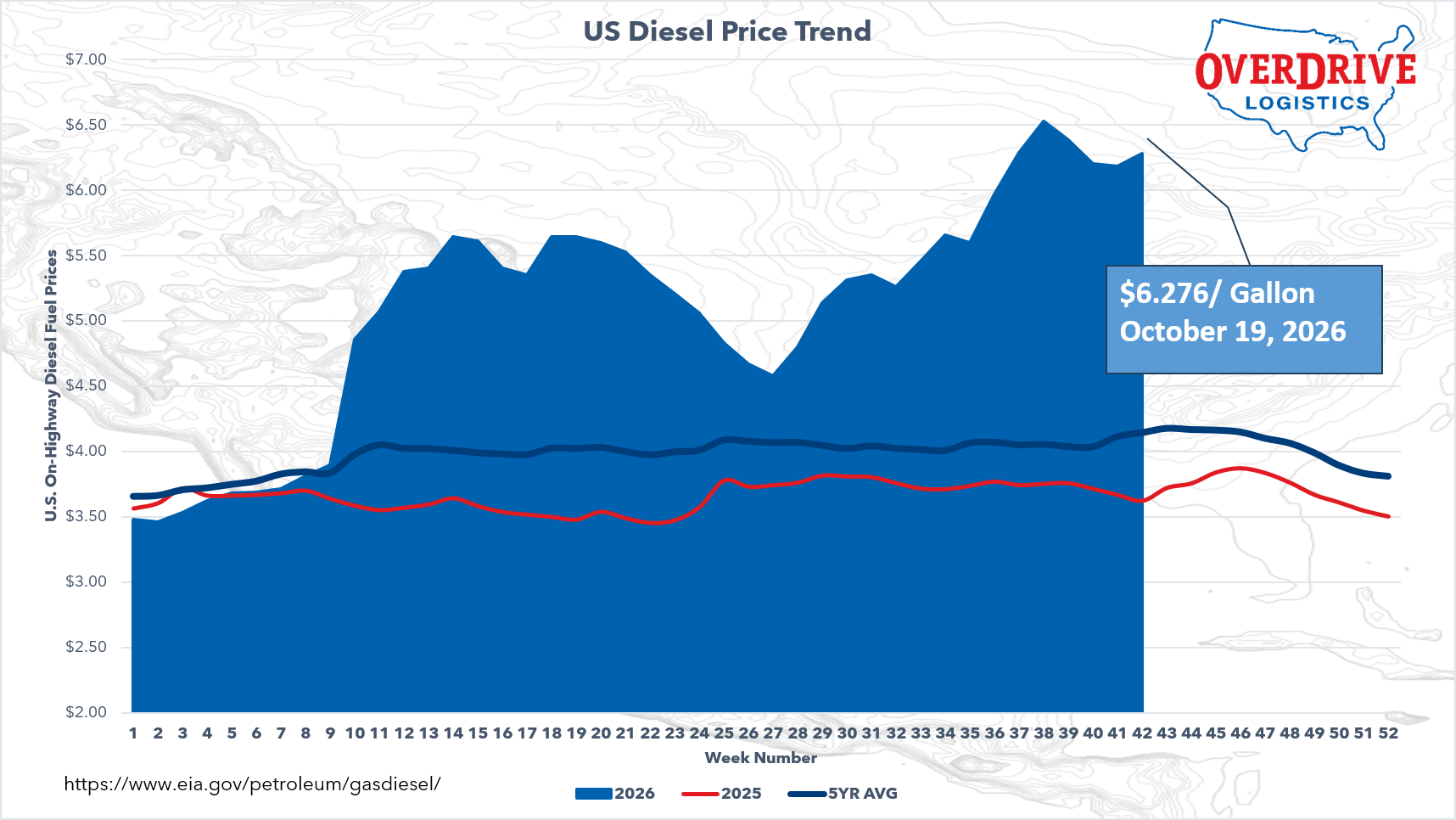
The latest numbers released by the U.S. Department of Energy’s Energy Information Administration show national on-highway diesel averaging $6.276 per gallon for the week of October 19, up 9.7 cents in one week.
Diesel is now $2.656 per gallon higher than it was a year ago.
More importantly, this week’s increase interrupts what had been an encouraging downward trend:
| Week | U.S. Diesel Average |
|---|---|
| September 21 | $6.529 |
| September 28 | $6.382 |
| October 5 | $6.199 |
| October 12 | $6.179 |
| October 19 | $6.276 |
After falling for three consecutive weeks, diesel jumped nearly a dime this week.
And this wasn’t an isolated regional increase.
Prices increased across every major U.S. region:
| Region | Oct. 12 | Oct. 19 | Weekly Change |
|---|---|---|---|
| U.S. Average | $6.179 | $6.276 | +9.7¢ |
| East Coast | $5.908 | $5.984 | +7.6¢ |
| Midwest | $6.259 | $6.352 | +9.3¢ |
| Gulf Coast | $5.809 | $5.903 | +9.4¢ |
| Rocky Mountain | $6.302 | $6.422 | +12.0¢ |
| West Coast | $7.240 | $7.394 | +15.4¢ |
| California | $8.091 | $8.242 | +15.1¢ |
The West continues to face the greatest fuel pressure. California is back above $8.24 per gallon, while the West Coast overall is averaging nearly $7.40.
Even the Gulf Coast—the least expensive major region—is still averaging $5.903.
For a tractor averaging 6.5 MPG, today’s national diesel price represents roughly 97 cents in fuel for every mile traveled.
A 1,000-mile trip therefore requires approximately $966 worth of diesel before paying for the driver, tractor, trailer, insurance, maintenance, tolls or anything else.
What does that mean for shippers?
The biggest takeaway is that we can’t assume the September fuel spike is behind us.
Three consecutive weeks of declining diesel prices had provided some reason for optimism. This week’s increase changes that picture.
The EIA currently expects retail diesel to remain above $6 during October before gradually declining, but it also expects distillate inventories to remain below their five-year average, which could keep diesel margins elevated.
For shippers, that means continuing to separate fuel from linehaul when evaluating transportation costs.
An all-in rate increase doesn’t necessarily mean the carrier is dramatically increasing its underlying linehaul price. Fuel alone can move the cost of a shipment significantly—particularly on longer-haul lanes.
Reefer Rates Continue to Climb Even as Freight Cools
The latest DAT data provides another indication that refrigerated capacity remains tight.
National reefer spot linehaul rates averaged approximately $2.76 per mile excluding fuel for the week ending October 17.
That’s up 32.7% year over year and approximately 28.8% above the nine-year seasonal average.
What’s particularly interesting is what’s happening beneath those numbers.
Freight demand has cooled from the quarter-end surge, but reefer pricing hasn’t followed it lower.
That again points toward capacity—not simply demand—setting the price.
For food, beverage and other temperature-controlled shippers, regional conditions matter enormously.
A refrigerated shipment originating in Washington or the Upper Midwest can face dramatically different market conditions than the same equipment moving out of Georgia, Texas or another relatively balanced market.
What does that mean for shippers?
Give refrigerated shipments additional lead time whenever possible.
And don’t assume last month’s rate—or even this week’s national average—represents the current market on your specific lane.
When rejection rates are elevated, flexibility around pickup dates and appointment times can sometimes make a meaningful difference in both capacity and price.
Contract Rates Are Moving Higher Too
The tightening market isn’t limited to spot freight.
Truckload contract rates have reached approximately $2.72 per mile plus fuel, representing a 52-week high and an increase of about 18% year over year.
That’s important because contract pricing typically reacts more slowly than the spot market.
A short-term disruption might send spot rates higher for a few days without materially changing annual transportation agreements.
When contract rates begin moving higher, it suggests that carriers and shippers are resetting longer-term agreements around a fundamentally different capacity environment.
At the same time, spot rates are significantly higher than they were a year ago.
What does that mean for shippers?
Don’t use one pricing strategy across your entire transportation network.
There are still lanes where shippers should be negotiating aggressively.
There are other lanes where dependable capacity may be worth more than squeezing another $50 or $100 out of the rate.
The key is knowing which market you’re buying in.
Record Imports Are Still Feeding Domestic Freight Networks
September was another strong month at U.S. ports.
U.S. containerized imports totaled approximately 2.55 million TEUs, making it the highest September on record.
That’s 10.3% higher than September 2025 and nearly 25% above September 2019, before the pandemic.

Why does that matter to a domestic transportation manager in mid-October?
Because those containers don’t stay at the port.
They eventually become drayage, warehouse, intermodal, truckload and LTL freight.
That means a significant amount of imported product is continuing to move into domestic distribution networks just as truck capacity is becoming more difficult to find.
What does that mean for shippers?
Watch markets around major ports and inland distribution hubs.
National capacity might look manageable while individual markets such as Southern California, Chicago, Dallas or Atlanta tighten quickly as freight moves inland.
More Freight Is Moving to Intermodal
One way shippers are responding to tighter truckload capacity and higher transportation costs is by moving more freight to rail.
For the week ending October 10, U.S. intermodal volume reached 302,252 containers and trailers, up 10.4% from the same week last year.
Through the first 40 weeks of 2026, U.S. railroads moved approximately 11.38 million intermodal units, up 4.4% year over year.
That doesn’t mean every long-haul truckload belongs on a train.
But it does mean it’s worth asking the question.
If you’re moving predictable dry-van freight 700, 1,000 or 2,000 miles and have some flexibility in transit time, intermodal may provide meaningful savings.
The same thinking applies to LTL, partial truckload and consolidation.
Sometimes the best way to reduce transportation spend isn’t negotiating another $100 off a truckload rate.
It’s finding a better way to move the freight in the first place.
For time-sensitive, high-value cargo, or service-intensive freight, a reliable party to move your freight over-the-road is still the best option and may be worth the extra expense.
What We Recommend Shippers Do Now
We’re approaching the part of the year when transportation planning becomes increasingly important.
Whenever possible, give providers three to five days of lead time. Review your routing guide now instead of discovering during Thanksgiving week that your primary carriers aren’t accepting freight.
Pay particular attention to refrigerated freight originating in the Northwest and Midwest, where capacity is currently much tighter than the national average.
Continue separating fuel from linehaul when reviewing freight rates. With diesel back above $6.27 nationally, fuel can materially change an all-in rate without necessarily indicating that underlying carrier pricing has increased by the same amount.
And don’t automatically assume every shipment needs the same transportation solution.
Truckload may be right for one shipment. Another may make more sense as LTL, partial truckload, consolidation or intermodal.
Most importantly, maintain relationships with dependable partners.
Saving $100 on a shipment doesn’t mean much if the cheaper truck misses pickup, fails a delivery appointment or forces you to recover the shipment at the last minute.
How OverDrive Logistics Can Help
This is exactly the type of freight market where a good logistics partner should earn its keep.
At OverDrive Logistics, our job isn’t simply to find you a truck.
Our job is to understand what’s happening in the market, understand what’s important about your shipment and then find the best combination of reliable capacity, price, and service.
Sometimes that means pushing aggressively on price because we know capacity is available.
Other times, it means telling a customer that a market is tightening and securing dependable capacity before rates move higher.
And sometimes the best solution isn’t a dedicated truck at all.
With nationwide capabilities across dry van, refrigerated, flatbed, LTL, partial truckload, consolidation, expedited and specialized freight, we can evaluate different options and determine what makes the most sense for the shipment.
That flexibility becomes particularly valuable in a market like this one, where conditions can be dramatically different depending on region and equipment type.
We also believe carrier quality matters.
As transportation costs rise and smaller carriers operate under greater financial pressure, saving a few dollars isn’t worth increasing exposure to service failures, cargo claims or fraud.
Our goal is simple: help our customers get dependable service at the best available market price—and make their transportation operation easier to manage.
What We’re Watching Next
Diesel: This week’s increase from $6.179 to $6.276 broke a three-week string of declines. The next DOE/EIA report will tell us whether this was a temporary bump or the beginning of another upward move.
Truckload capacity: National tender rejections remain near 13.9% despite accepted freight volumes falling more than 4% over the past month. That’s one of the clearest signs that excess capacity has largely disappeared.
Northwest reefer: Overall Northwest rejections reached 20.27%, while reefer-specific rejections have averaged approximately 41% during October. We’ll be watching for that pressure to ease as harvest activity winds down.
Midwest capacity: The Midwest’s 18.6% overall rejection rate may be even more important to the national market because its tightness is broader and has persisted much longer than the seasonal Northwest spike.
Holiday freight: Thanksgiving is approaching. A transportation network with limited excess capacity doesn’t require a massive freight surge to tighten significantly.
Intermodal: Rail continues to absorb additional long-haul freight and may become increasingly attractive if truckload rates and diesel remain elevated.
Bottom Line
The freight market isn’t booming.
That’s exactly what makes what’s happening so important.
Truckload volumes aren’t surging, yet tender rejections remain elevated, contract rates are moving higher and regional capacity is becoming increasingly difficult—especially for refrigerated freight.
Now diesel has reversed three weeks of declines and moved back up to $6.276 per gallon.
Put it all together and the message for shippers is fairly straightforward:
There isn’t much slack left in the transportation system.
With Thanksgiving, the holidays and winter weather ahead, it won’t take a massive increase in freight demand to tighten the market further.
For shippers, this is the time to plan earlier, understand what’s happening on your individual lanes, keep dependable carriers close and stay flexible about how your freight moves.
That’s how you protect service—and avoid paying more than you need to when the market gets tight.
For more information, or to speak with our team, contact us today:


Sources:
DOE/EIA — Latest Diesel Prices
FreightWaves — Northwest and Midwest Capacity Analysis
FreightWaves — National Truckload Capacity Update
DAT — Latest Reefer Market Report
Descartes – Global Trade Intelligence