
News
Q4 2026 Shipper Outlook: Truckload Rates, Capacity and Volume
Expect Q4 to cost more than last year, with less carrier reliability. The cause is fewer trucks and $6.50 diesel, not stronger demand. Spot rates are almost level with contract rates, so when carriers turn down your contract loads, the replacement loads won’t cost much more but will be harder to cover. That risk peaks in December.
Rate forecast ($/mile)

- Spot linehaul is only about $0.23/mi below contract. A year ago the gap was $0.55, and in Q2 and Q3 spot went above contract at times. Expect more of your contract loads to end up on the spot market.
- Fuel is about $1.05/mi, roughly 30% of the all-in rate. Diesel is driving the cost increase more than linehaul is.
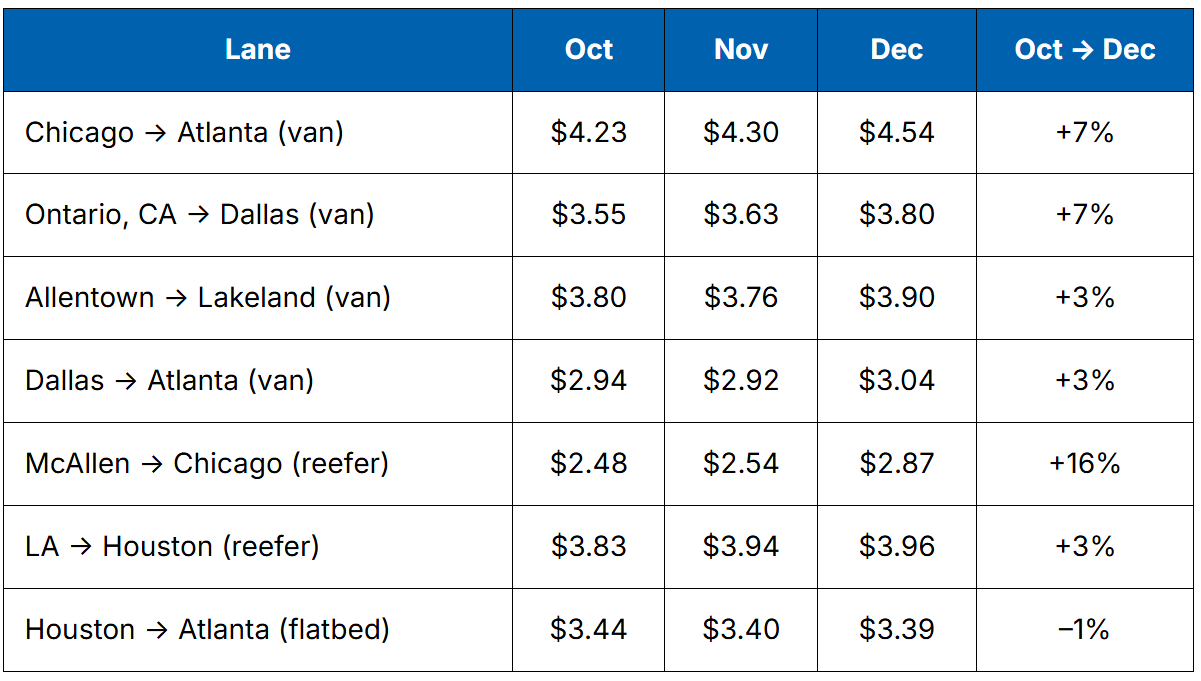
Lane forecasts (SONAR median, $/mile all-in)
Capacity: tight now, with early signs of easing in 2027
- About 1 in 8 contract loads is being rejected (12.7%), compared with 1 in 17 last year. Reefer is at 22%, van at 13% and flatbed at 18%.
- There are fewer trucks on the road. SONAR counts about 2.02M tractors and about 207K for-hire fleets, both down about 2% YoY.
- New carriers are entering the market. Net new authorities have been running at +800 to +2,000 per week since August, compared with roughly zero last year. That’s too late to help in Q4, but it points to some relief in Q1–Q2 2027.
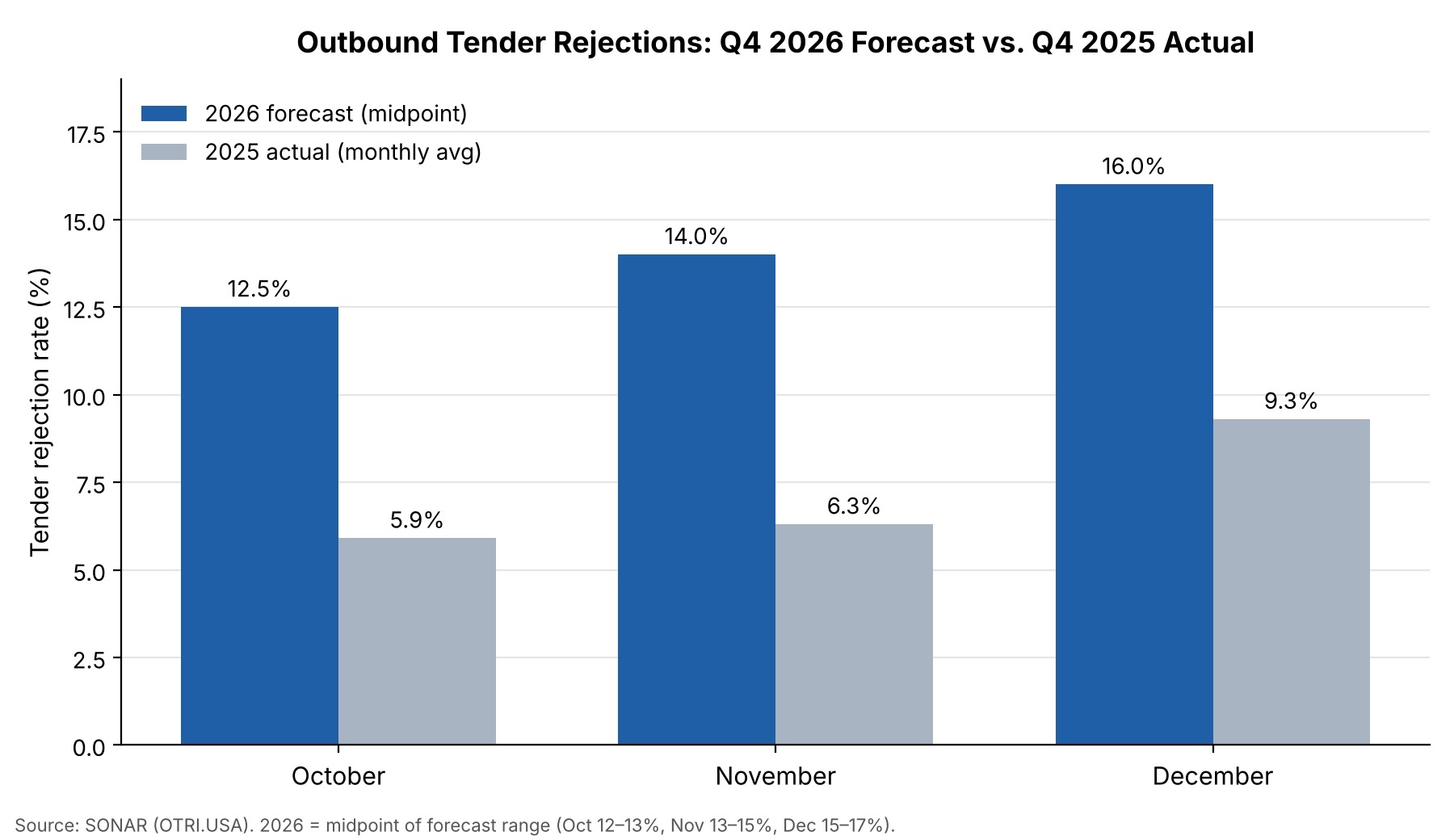
Rejection forecast: 12–13% in October, 13–15% in November and 15–17% in December. Last year, rejections doubled during December.
Volume forecast: flat demand, but more imports
- Truckload demand is flat YoY. Tender volume is about even with Oct 2025. I expect it to rise about 2–3% into December, which matches last year’s seasonal pattern.
- Imports are up about 20% YoY, at about 108K TEUs/day. This will add pressure on port drayage and inland distribution through November.
- Intermodal is about $1.60/mi cheaper than truck spot, compared with $0.86 a year ago, and rail volumes are at a cycle high.
- Ocean rates are about 2.4x last Q4. Shanghai → LA is at about $7,800/FEU, so budget for higher landed costs.
Outlook by month
- October (the window to act): This is the seasonal lull, with rejections at 12–13% and spot at about $3.55. It’s the best time to lock in capacity and award mini-bids.
- November (retail peak and Thanksgiving): Rejections reach 13–15%. Reefer tightens in South Texas and the Southeast, and port-area lanes get busier with imports.
- December (highest risk): Rejections reach 15–17% and spot hits $3.75–4.00+. More loads fall to spot, and holiday weeks will see coverage delays.
What shippers should do
- Lock in capacity now. Use dedicated or committed-volume deals with core carriers on your top lanes before mid-November.
- Give carriers more lead time and be more flexible. Tender earlier, widen pickup windows and cut detention. Carriers are choosing which shippers to serve.
- Move freight to intermodal on lanes over 700 miles that aren’t time-sensitive. The savings are about double last year’s.
- Budget for fuel risk separately. Review your fuel surcharge tables. A $0.50/gal move in diesel changes all-in rates by about $0.08/mi.
- Plan for reefer early. Lock in produce and holiday protein capacity for November and December now.
Source: SONAR, data through Oct 4, 2026. NTI and lane rates are SONAR forecasts. The contract and volume ranges are my projections from current trends and last year’s Q4 seasonality.
The October 1 Trucker Shutdown: What Actually Happened?
For several weeks, social media promoted claims that tens of thousands of truckers would park their equipment beginning October 1 in protest of diesel prices and other industry issues.
As I reported previously, there was never evidence of a centrally organized nationwide strike.
That assessment appears to have been correct.
While some independent drivers publicly committed to parking their trucks and isolated participation did occur, there is no evidence that the event produced a broad nationwide freight shutdown or measurable national capacity shock.
The Owner-Operator Independent Drivers Association explained that it could not organize such a shutdown because owner-operators are independent businesses and coordinated rate-setting or boycotts can raise antitrust issues. Land Line Media
But don’t ignore what caused the rumor.
The strike itself wasn’t the important freight signal.
Carrier financial stress is.

FreightWaves identified at least 16 trucking, delivery and transportation companies entering bankruptcy proceedings between late August and September 21. FreightWaves
Today’s diesel costs, insurance premiums, equipment expenses and historically thin margins are putting enormous pressure on smaller fleets and owner-operators.
The Owner-Operator Independent Drivers Association is warning that additional carrier closures are possible if fuel prices remain elevated. The Wall Street Journal
Shipper takeaway: The October 1 strike wasn’t the capacity event to fear. Continued carrier attrition may be far more important to freight markets over the next several months.
C.H. Robinson is Buying RXO
On October 5, C.H. Robinson, North America’s biggest freight broker, agreed to buy RXO, one of its largest competitors, for about $5.8 billion. RXO already owns Coyote Logistics, so three well-known broker brands are becoming one company.
The combined company will handle more than $25 billion in freight a year for about 93,000 shippers, using about 600,000 trucking companies. The deal is expected to close in the first half of 2027.

Why are they doing it?
It comes down to scale and cost. C.H. Robinson has spent the last few years using AI and automation to move more freight with fewer people. It wants to run RXO’s freight the same way, and it expects to save about $300 million a year by doing so.
The timing matters too. Trucking capacity is getting tight again, and in a tight market the brokers with the most trucks on call win the business.
What it means for shippers
The good: One company with a huge network of carriers could make it easier to find a truck on hard lanes and during busy seasons. Expect faster quoting and more automated tools.
The not-so-good:
- Fewer choices. If you use both companies today, you’ll soon get one bid instead of two, and less competition can mean higher prices.
- Growing pains. When two companies merge, account reps change, systems switch over and service can slip for a while, most likely in 2027 and 2028.
- Less discounting. C.H. Robinson is taking on debt to pay for the deal, so it will be focused on protecting its profit on every load.
What won’t change yet
For now, nothing. The two companies stay separate and keep competing until the deal closes in 2027. Your current rates, contacts and contracts stay the same for now.
What to do now
- Check your exposure. Add up how much of your freight goes to C.H. Robinson, RXO and Coyote together. If it’s a big share of your key lanes, that’s a risk.
- Use the competition while it lasts. In your next bid, make them compete against each other and lock in rates for 12 months.
- Keep other options. Add or grow other brokers, asset carriers and intermodal so you’re not relying on a single company.
- Ask questions. Ask your reps who your contact will be after the merger and how your systems and EDI will change.
The wrap-up: How OverDrive Logistics can help
This quarter, shippers face two challenges at once: a tight trucking market and fewer big broker choices.
- Trucks are harder to find. About 1 in 8 loads is being turned down by carriers today, and that could reach 1 in 6 by December.
- Rates are rising. Spot rates are up about 50% from last year and could reach $3.75–$4.00 a mile around Christmas, with diesel near $6.50 a gallon.
- The big brokers are getting bigger. C.H. Robinson buying RXO means one less large option to compete for your freight.
That’s where OverDrive Logistics fits in.

The bottom line: The market is tightening and the big players are combining. Shippers who line up dependable partners now will have an easier December and a stronger 2027.
Let us move you forward. Call (800) 866-7282 or request a quote at overdrivelogistics.com.
Prepared by OverDrive Logistics for customer education and market awareness.
Source references include FreightWaves, EIA, SONAR, NOAA, U.S. Energy Information Administration, AAA, and industry reporting.
- FreightWaves: C.H. Robinson acquiring RXO (Oct 5, 2026)
- C.H. Robinson acquires RXO, deal site
- Transaction press release (PDF)
- Investor presentation (PDF)
- C.H. Robinson investor relations
- SONAR: OTRI.USA and NTI.USA, data through Oct 4, 2026
- LandLine Media: Why Doesn’t OOIDA Call For A Strike?