
News
U.S. Freight & Logistics Market Report – September 21, 2026
U.S. Freight & Logistics Market Report

Tony Broyles
September 21, 2026 | Shipper Update | 6–9 Minute Read
Freight Market Under Pressure: Record Diesel, Tight Capacity and New Risks Ahead
The U.S. freight market is entering Q4 with record-high diesel prices, tightening truckload capacity, strong import volumes and increasing winter-weather risk, while social media reports of a potential October 1 trucker shutdown are adding uncertainty.
Although there is currently no credible evidence of an organized nationwide strike, the financial pressure behind the movement is real and even localized disruptions could affect an already-tight freight market.
For shippers, now is the time to increase tender lead times, secure backup capacity and closely monitor fuel and lane-level conditions.
OverDrive Logistics can help navigate this volatility by using current market intelligence and a nationwide network of vetted carriers to secure the best combination of service, capacity and price.
Diesel Hits $6.285 — and California Breaks $8

Fuel remains the biggest immediate cost issue for shippers.
The latest U.S. Energy Information Administration weekly benchmark shows national on-highway diesel reaching $6.285 per gallon on September 14, up another 31.8 cents in one week. Diesel is now $2.546 per gallon higher than one year ago.
The regional numbers are even more striking:
| Region | Sept. 14 Diesel |
|---|---|
| U.S. Average | $6.285 |
| East Coast | $6.158 |
| Midwest | $6.250 |
| Gulf Coast | $6.027 |
| Rocky Mountain | $6.066 |
| West Coast | $7.250 |
| California | $8.039 |
California crossing $8 per gallon is particularly significant. The national average has increased from $5.599 on August 31 to $6.285 in only two weeks—an increase of nearly 69 cents per gallon.
For perspective, a tractor averaging 6.5 MPG now consumes roughly 97 cents of diesel for every mile traveled. A 1,000-mile trip therefore requires approximately $967 of fuel alone.
💡Shipper takeaway: Linehaul pricing no longer tells you enough. Fuel surcharge structure, deadhead, routing and equipment positioning can materially change the actual cost of a shipment. Evaluate transportation bids using the all-in rate.
EIA Gasoline and Diesel Fuel Update
Truck Capacity Tightens Again — and This Time It Isn’t Seasonal
Perhaps the week’s most important trucking development is what happened after Labor Day.
National tender rejections unexpectedly climbed to 14.32% following the holiday. More importantly, FreightWaves reports that the increase is broad-based rather than being caused by one isolated market or normal seasonal event. Dallas, Chicago, Atlanta and Harrisburg have all experienced deteriorating carrier acceptance.
That matters because tender rejections are a good indication of how willing contracted carriers are to accept freight at previously negotiated prices.
As rejection rates rise, more freight spills into the spot market.
Refrigerated capacity is also tightening as fall harvest activity increases in produce-heavy regions, including Idaho, Iowa and the Dakotas.
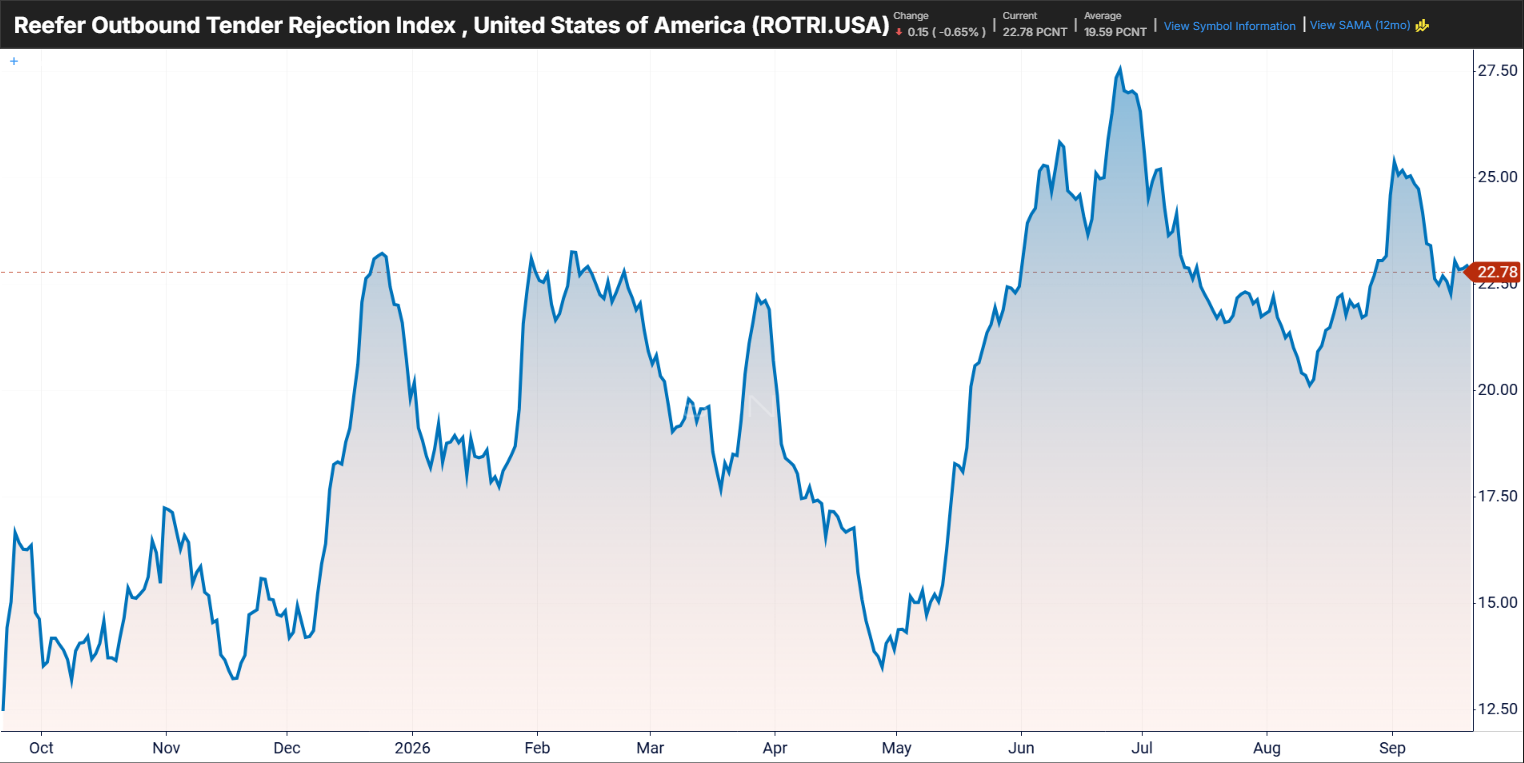
Reefer Tender Rejections remain above 22% after a brief dip in June.
The key point for shippers is that capacity still has not rebuilt meaningfully.
Recent carrier commentary suggests the capacity correction may actually have further to run. Trucking executives told investors last week that the industry’s capacity exodus remains in its early stages as regulatory enforcement continues removing noncompliant drivers and carriers from the market.
💡Shipper takeaway: Don’t expect the normal post-Labor Day rate decline to automatically materialize. Tender important freight earlier, protect reliable carrier relationships and identify backup capacity before Q4 volume arrives.
The Rumored October 1 Trucker “Strike” — What Shippers Need to Know
Another story gaining significant attention across social media is a supposed nationwide trucker shutdown beginning October 1 in response to record-high diesel prices.
Videos and graphics circulating on Facebook, Instagram, TikTok, X and Reddit claim that truck drivers and owner-operators plan to park their trucks beginning October 1, with some posts claiming that 50,000 drivers have committed to participate.
At this point, however, there is no credible evidence of an organized nationwide trucker strike.
The rumor appears to have gained momentum after a social-media video posted September 15 encouraged truckers to “park it” beginning October 1. The message was subsequently reposted across multiple platforms, along with AI-generated graphics and increasingly dramatic claims about potential food and supply shortages.
The Owner-Operator Independent Drivers Association (OOIDA), which represents approximately 150,000 members operating more than 240,000 trucks and fleets, told fact-checkers that its awareness of the alleged strike was consistent with it being “social media chatter at this point in time.” No major trucking organization or labor organization has announced or confirmed a coordinated nationwide October 1 work stoppage.
The Strike May Be a Rumor — But the Frustration Behind It Is Real
The lack of an organized strike doesn’t mean the underlying concern should be ignored.
Diesel has continued climbing to unprecedented levels. AAA’s national diesel average reached approximately $6.50 per gallon on September 20, compared with roughly $3.70 one year earlier.
For an owner-operator purchasing hundreds of gallons every week, that increase represents thousands of dollars in additional monthly operating expense.
The federal government has also taken steps to address fuel-distribution concerns. On September 16, the U.S. Department of Transportation announced a temporary 90-day Hours-of-Service waiver for qualified drivers transporting gasoline and diesel, allowing additional operating flexibility intended to help alleviate short-term fuel supply-chain pressures.
So while there is currently no verified nationwide October 1 strike, the economic pressure affecting carriers is very real.
Could Social Media Still Affect Freight Capacity?
Potentially.
Modern social-media movements do not necessarily require a traditional union or industry association to gain participation. Individual owner-operators could independently choose to park their trucks or participate in informal protests.
There is currently no reliable evidence indicating that participation would occur on a scale large enough to materially disrupt the national freight network. But with truckload tender rejections already above 14% and available capacity tighter than in recent years, even localized participation could temporarily affect individual markets or lanes.

The viral video about a truckers’ strike was created by a right-wing creator called Red Pill Patriot 1776
That is why OverDrive Logistics will continue monitoring the situation as October 1 approaches.
What Shippers Should Do
At this point, we do not recommend changing inventory or transportation strategies based solely on the strike rumor.
Instead, shippers should treat it as another reason to maintain good transportation fundamentals heading into October:
- Tender critical shipments early.
- Maintain backup capacity on important lanes.
- Avoid waiting until the day before pickup to secure difficult freight.
- Monitor regional capacity and spot-rate movement.
- Separate verified transportation-market information from social-media speculation.
If credible evidence of an organized shutdown develops, the transportation market could respond quickly. Until then, the much more important issues for shippers remain record diesel prices, elevated tender rejections, Q4 freight activity and tightening carrier economics.
How OverDrive Is Responding
OverDrive Logistics is monitoring carrier availability, freight-market data and developments surrounding the October 1 rumors.
Our role is to help customers distinguish between market noise and information that actually requires action.
If conditions begin changing, OverDrive can use its nationwide carrier network and real-time market intelligence to identify tightening markets, secure alternative capacity and help customers make informed decisions before disruptions affect their freight.
For now, our message to shippers is simple:
Be prepared — but don’t panic over an unverified social-media rumor.
The October 1 strike has not been substantiated. The financial pressure facing America’s trucking companies, however, is very real — and that is the issue shippers should continue watching closely.
U.S. Imports Just Posted Their Third-Highest Month Ever
There is also considerably more freight entering the country than headlines about an uneven economy might suggest.
U.S. containerized imports reached 2.60 million TEUs in August, increasing 3.8% from July and 3.3% year over year.
That was the third-highest monthly import total on record and 21.5% above August 2019’s pre-pandemic level.
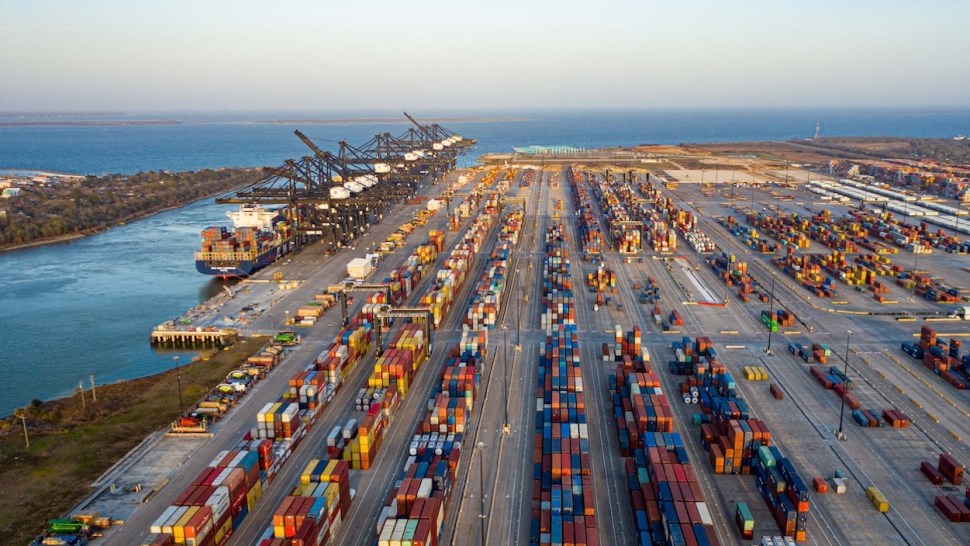
FreightWaves reports August Imports were the 3rd highest of all time.
The growth was geographically broad.
Savannah increased 9.2% month over month, New York/Newark rose 7.2%, and Houston increased 4.7%. Eight of the country’s 10 largest container gateways reported increases.
However, higher volumes are beginning to create operational pressure. Transit delays increased across all 10 major ports tracked in the report. Houston’s average delay increased from 4.3 to 5.8 days, Seattle reached 7.6 days, and Savannah climbed to 6.1 days.
For domestic shippers, those containers eventually become truckload, intermodal, drayage and warehouse freight.
💡Shipper takeaway: Watch major import gateways and inland distribution markets carefully. Strong import activity combined with constrained trucking capacity can create regional rate increases even if national freight demand appears moderate.
Asia–U.S. Ocean Rates Are Approaching Pandemic Records
International transportation is adding another layer of cost pressure.
As of September 17, Far East-to-U.S. West Coast ocean spot rates reached approximately $7,960 per FEU, while Far East-to-U.S. East Coast rates reached $11,259 per FEU.
Those rates have increased approximately 324%–325% since late February.
Even more striking, East Coast pricing is now only about 11% below the all-time pandemic-era record, while West Coast pricing is approximately 18% below its previous peak.
Carriers are adding capacity, which could eventually slow the increases. But another rate push is possible ahead of China’s Golden Week as shippers accelerate exports before factory shutdowns.
For U.S. shippers importing goods, higher ocean costs don’t end at the port. They increase landed cost and can influence inventory strategies, warehousing decisions and domestic transportation requirements.
💡Shipper takeaway: Importers should evaluate international and domestic transportation as a connected network rather than separate procurement exercises.
What Shippers Should Be Doing Now
The current market doesn’t call for panic. It does call for more deliberate transportation management.
Shippers should increase lead time on important shipments, review Q4 routing guides, identify lanes where reefer or harvest activity may create regional shortages, establish backup capacity and closely audit fuel-surcharge programs. Long-haul freight should also be evaluated for intermodal or consolidation opportunities where service requirements allow.
Most importantly, avoid making transportation decisions based solely on the lowest quoted linehaul rate. Carrier quality, fuel, service reliability and the probability of failure all have a cost.
How OverDrive Logistics Can Help
OverDrive Logistics helps shippers manage exactly these types of market conditions.
OverDrive provides nationwide dry van, temperature-controlled, flatbed, drayage, expedited, LTL, partial truckload, consolidation and specialized transportation solutions, supported by dedicated account teams and 24/7 U.S.-based operations.
The advantage in a volatile market is flexibility.
Rather than simply accepting the first available truck, OverDrive can evaluate current lane conditions, carrier availability, equipment requirements and alternative transportation options to help determine the best combination of service and price.
OverDrive’s nationwide vetted carrier network also provides shippers with additional capacity when primary routing guides fail or regional markets suddenly tighten. The company’s stated approach emphasizes long-term relationships, customized transportation solutions, freight security and market knowledge rather than purely transactional freight procurement.
For shippers, the objective should be straightforward:
Negotiate aggressively where capacity allows it. Protect dependable capacity where the market demands it. And never sacrifice carrier quality simply to save a few dollars on the quoted rate.
OverDrive Logistics shipper solutions
What We’re Watching Next
Diesel: After increasing nearly 69 cents in two weeks to $6.285, fuel remains the single biggest near-term transportation-cost risk. The next EIA release will show whether the acceleration is continuing.
Tender rejections: The move to 14.32% is unusual because it occurred after Labor Day and is geographically widespread. If rejections continue rising, spot pricing is likely to follow.
Q4 freight: August’s near-record imports will move through ports, warehouses and domestic transportation networks as retailers position inventory for the holiday season.
Ocean freight: Asia–U.S. rates are approaching pandemic-era records, with another potential increase ahead of Golden Week.
Winter weather: With El Niño effectively certain through the core winter months, weather-related capacity disruption becomes an increasingly important planning consideration.
Bottom Line
The freight market is becoming more expensive without experiencing a traditional demand boom.
That is what makes the current environment unusual. Record fuel costs, shrinking excess truck capacity, strong imports, rapidly rising ocean rates and winter weather risk are converging at the same time.
For shippers, the next several weeks provide an important opportunity to prepare. Companies that understand their individual lanes, secure dependable capacity early and use current market intelligence to distinguish between legitimate rate pressure and unnecessary cost increases should be best positioned to protect both service and transportation spend heading into Q4.
Prepared by OverDrive Logistics for customer education and market awareness.
Source references include FreightWaves, EIA, SONAR, U.S. Energy Information Administration, and industry reporting.